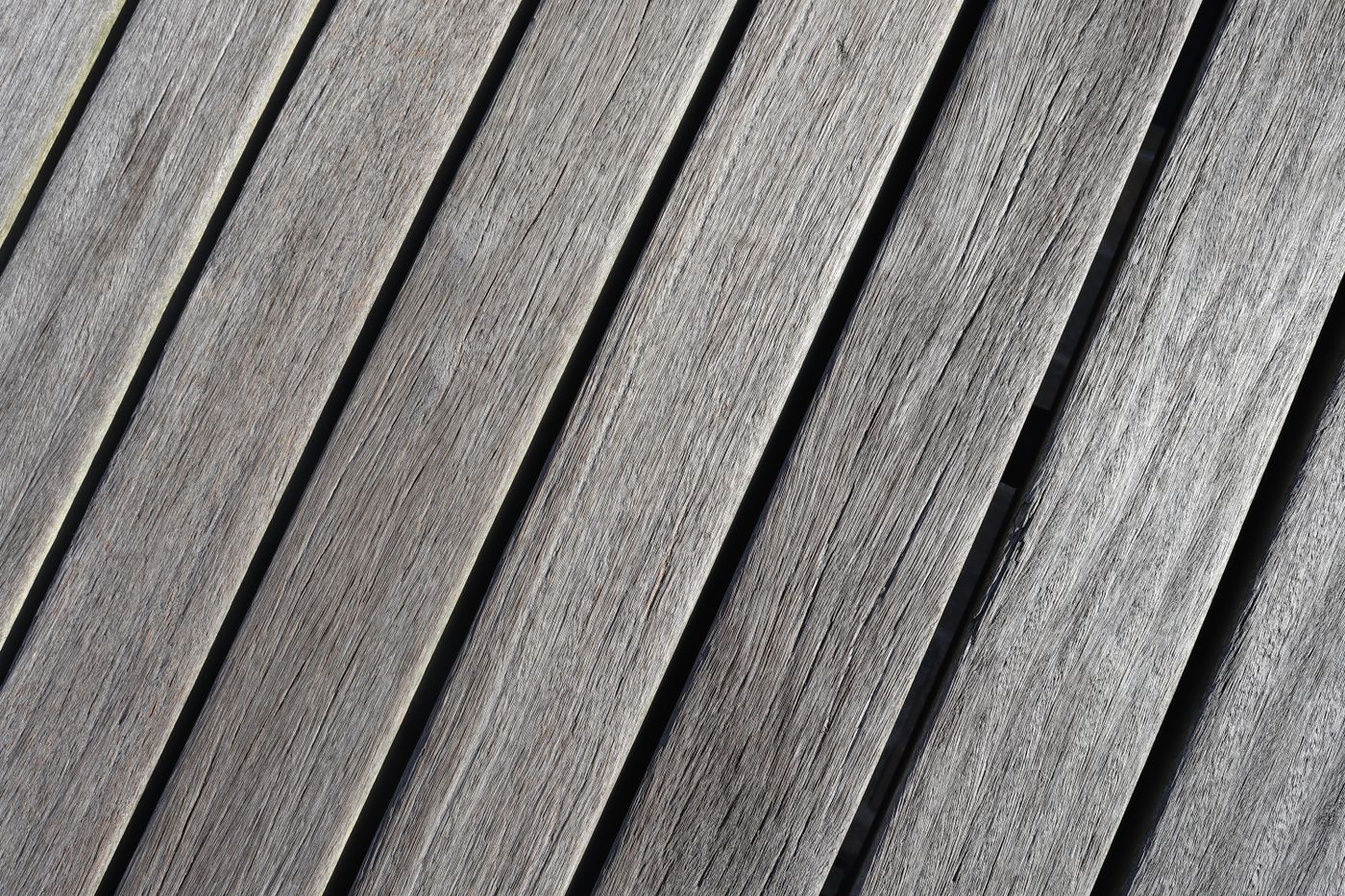
On an old or weathered deck, the colors open to you depend on what is on the wood now. Gray, unfinished boards and a worn oil-based stain can both be cleaned and given a new penetrating stain. A cracking or peeling film has to come off completely first, because a penetrating stain can’t go over it. Work out which of these you have before you choose a color.
Find out what is on your deck first
Look closely at the boards in daylight and match them to one of these.
| What you see | What it is | What it means for color |
|---|---|---|
| Gray wood with no finish left | Unfinished, weathered wood | Clean off the dead gray fibers before staining |
| Chalky and dull, wearing evenly | A weathered oil-based stain | A cleaner that removes light oil finishes gets it ready for a new stain |
| Flaking, lifting, shiny in spots | A cracking or peeling film-forming finish | Strip it to bare wood before any penetrating stain |
| A thick coat like paint over the boards | A resurfacer such as Behr DeckOver, Olympic Rescue It or Rust-Oleum Restore | Text a photo for advice before you buy anything (see below) |
A peeling film can’t be cleaned and covered. “Just clean and recoat” over a finish that is failing unevenly gives a blotchy result, and a new solid stain over a failing solid stain peels too. The way back to bare wood is a caustic stripper, then a citric acid brightener, which counteracts the caustic and restores the wood’s tone, and then the stain.
Why gray wood changes the color you get
The gray on old wood is a layer of dead fibers, and those fibers change how a stain takes. Bleach-based deck cleaners lighten the gray but leave the fibers on the surface. A peroxide-based cleaner releases the lignin that holds the dead fibers in place, so they rinse away. A stain also looks different on weathered wood than on new wood, so judge any sample on boards that have already been cleaned.
Prep and staining happen on different days. Clean one day and stain the next, once the wood has dried. In good weather most decks are dry enough by then: the wood lightens back toward its normal color and stops feeling cool and damp. Check the slowest spots, the shaded boards near the house and the end grain of stair treads.
Colors that work on weathered wood
Once it is clean, an old deck in reasonable shape can take a semi-transparent stain. It evens out minor discoloration and differences between boards while the grain still shows. What decides how much grain you see is the type of pigment. Transparent iron oxide pigments block UV and still let you see the wood. A clear finish is a poor fit for an old deck, because an unpigmented clear gives very little UV protection.
For a warm tone on a weathered softwood deck, Woodrich’s Timber Oil Deep Penetrating Wood Stain is made for cedar, pressure-treated pine, redwood and similar woods. It comes in Warm Honey Gold, Brown Sugar, Amaretto, Western Cedar, Signature Brown and Clear Advantage. It is guaranteed not to crack or peel, and keeping it up means cleaning and putting on another application, with no stripping. Its coverage figure, 150 sq ft per gallon, is based on aged, rough cedar, so it fits an old, rough deck. Woodrich lists its products for this job on its Restore a Weathered Deck page.
If your deck is pressure-treated pine, the pressure-treated wood guide covers how pine takes color. Other species are under deck stain colors by wood type.
When a solid stain makes sense on an old deck
A solid stain is the option when the boards are too far gone to show: badly weathered, mismatched after repairs, or cracked. It covers all of that with one even color. The trade-off is that it forms a film, and on a deck a film cracks and peels because it can’t flex as the wood moves. A USDA technical report, GTR-106, says opaque stains should not be used on decks. Once a solid stain is on, you can’t go back to a penetrating stain without stripping to bare wood.
Woodrich doesn’t make a solid or semi-solid stain. If you decide on one, Benjamin Moore Arborcoat is a good place to start, and the solid deck stain colors guide explains the category.
Getting a gray or driftwood look
If you like the gray look, you need a brand that makes gray stain, and Woodrich doesn’t. Armstrong-Clark makes an oil-based penetrating stain with a Driftwood gray, and TWP makes several grays. The gray deck stain colors guide has more on gray.
Decks with a resurfacer coating
A resurfacer such as Behr DeckOver or Olympic Rescue It is a thick paint laid over the damage, and it is hard to remove. Before you buy any remover or stain for one, text a photo of the deck to the Woodrich Project Support Hotline, (636) 288-8512, for a personal answer on what is on the wood, what to use and how much to order.
How to test a color on old wood
Test on cleaned boards, not gray ones. Brush two or three colors onto a spot nobody looks at and let each dry for 24 to 48 hours before you judge it. The Timber Oil Sample Color Kit costs $15 for five 2 oz bottles, one of each pigmented color, and the $15 is credited toward your full order. The guide to testing deck stain colors has more on sampling.